03-13-Daily - AI Hot Daily
AI Hot Daily 2026/3/13
Daily curated AI + indie dev news
Today’s Summary
Axe is a lightweight AI Agent framework designed to provide indie developers with tools to build efficient, low-resource AI applications.
OneCLI addresses AI Agent API key security risks through a proxy mechanism, ensuring sensitive credentials are not leaked.
EigenFlux is a global broadcast network for Agents, enabling efficient peer-to-peer communication and information matching.
AI Tech & Products
Axe: Lightweight AI Agent Framework ⭐ 9.5
Axe is a Go language CLI tool, only 12MB in size, designed to provide a lightweight, focused, and composable AI Agent framework, contrasting with traditional large AI frameworks. It allows developers to define and chain AI Agents like Unix programs, supporting CLI pipelines, sub-agent delegation, persistent memory, and multiple model providers. This is valuable for indie developers looking to build efficient, low-resource AI applications.
OneCLI: Rust Agent Key Vault ⭐ 9
OneCLI is an open-source gateway built with Rust, aiming to solve the security risk of AI Agents directly holding API keys. It uses a proxy mechanism where Agents use placeholder keys, and the actual keys are injected by OneCLI at the time of the request. This provides indie developers with a more secure Agent integration solution, effectively preventing Agents from leaking sensitive credentials during Prompt Injection attacks, and is a cornerstone for building trustworthy AI applications.
EigenFlux: Agent Broadcast Network Launched ⭐ 9
An AI startup team from MiniMax, ByteDance, and Meta has launched EigenFlux, a global broadcast network designed for Agents to enable peer-to-peer communication and information matching. For indie developers, this means Agents can more efficiently acquire, filter, and respond to information, such as automatically finding housing, projects, or real-time market signals, significantly reducing token consumption and potentially fostering new Agent application scenarios.

OpenAI Building Computer Access Capabilities for Agents ⭐ 9
OpenAI shared engineering practices and experiences from their Responses API, showcasing the technical architecture for building computer access capabilities for AI Agents. This includes the evolution from Python sandboxes to full Unix Shell environments, the orchestration loop of the Agent Loop, container context management, context compression, and a reusable Skills system. Indie developers can learn from this how to make AI Agents operate computers more like humans, handle complex workflows, and achieve continuous learning and enhancement for Agents, building more powerful automation tools.

New Method to Prevent AI from Repeating Mistakes ⭐ 8.5
The NeurIPS 2024 paper ParamMem proposes using Lora to enable AI models to “learn reflection patterns” to solve the problem of repeating mistakes, with significantly improved results. This research offers important insights for indie developers, suggesting that in AI Agent design, one can explore teaching models higher-level thinking patterns, rather than relying solely on prompts or database searches, thereby improving the intelligence and robustness of Agents.
Hermes Agent: Open-Source Autonomous Learning Agents ⭐ 8.5
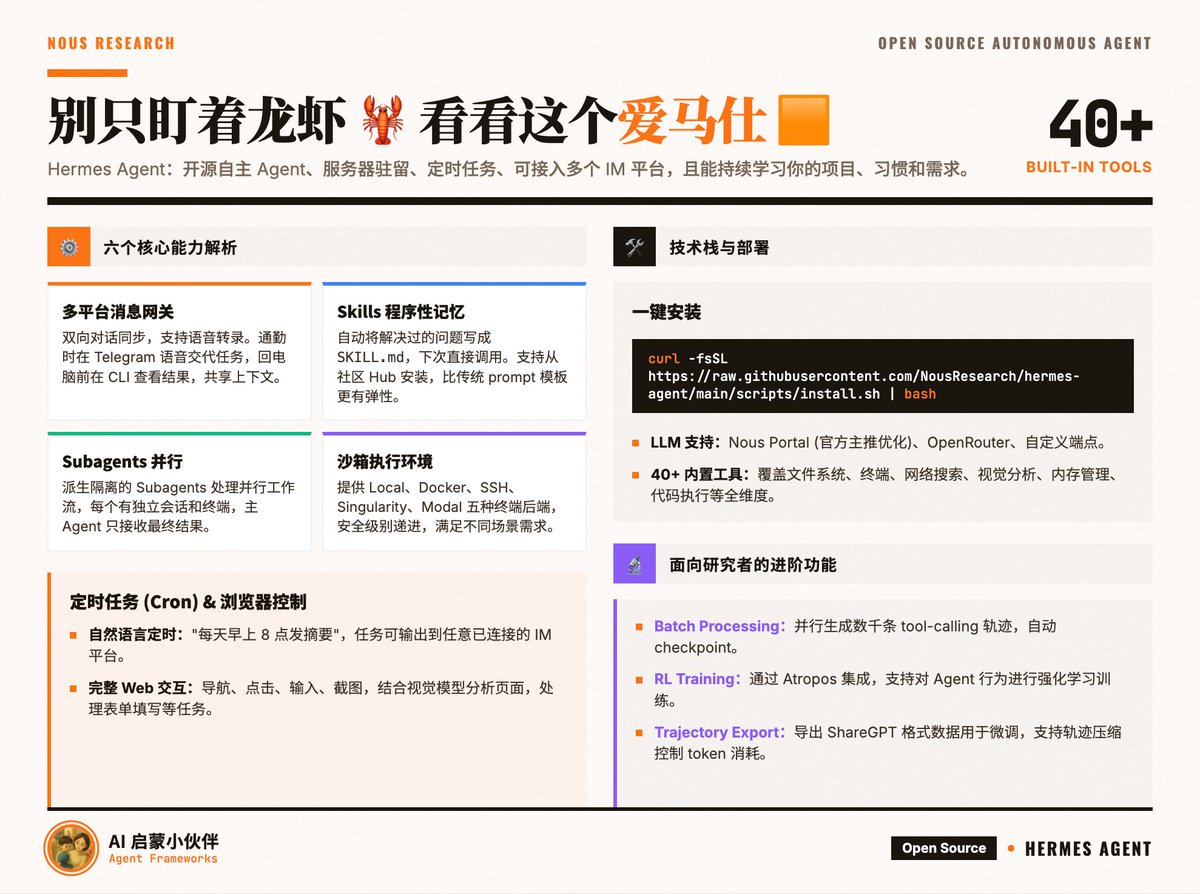
Nous Research has launched the open-source “Hermes Agent,” an Agent with a multi-platform message gateway, skill system, scheduled tasks, parallel sub-agents, and a sandbox execution environment, capable of continuously learning user habits and needs. For indie developers, this means the ability to build highly personalized, automated assistants, improving work efficiency by integrating mainstream IM platforms and reusable skills, while balancing security and flexibility.
Karpathy: We Need Bigger AI IDEs ⭐ 8.5
Andrej Karpathy believes the era of IDEs is not over, and the future AI era will require “bigger” IDEs to adapt to higher-level programming with Agents as fundamental units. This suggests that indie developers will need new development tools to manage and orchestrate multiple Agents when developing Agents, improving development efficiency and Agent controllability, which is a noteworthy trend in AI development tools.

Will AI-Assisted Programming End Programmers? ⭐ 8
A New York Times article discusses the impact of AI on the programming industry, pointing out that while AI may generate hallucinatory code, software development has the “unique ability to detect if code is running correctly” to circumvent this. Simon Willison believes this gives programmers an advantage in this wave of AI, and indie developers should consider how to use AI tools to improve efficiency and focus on more creative and verification-oriented work.
OpenRouter’s Stealth Models Attract Attention ⭐ 7.5
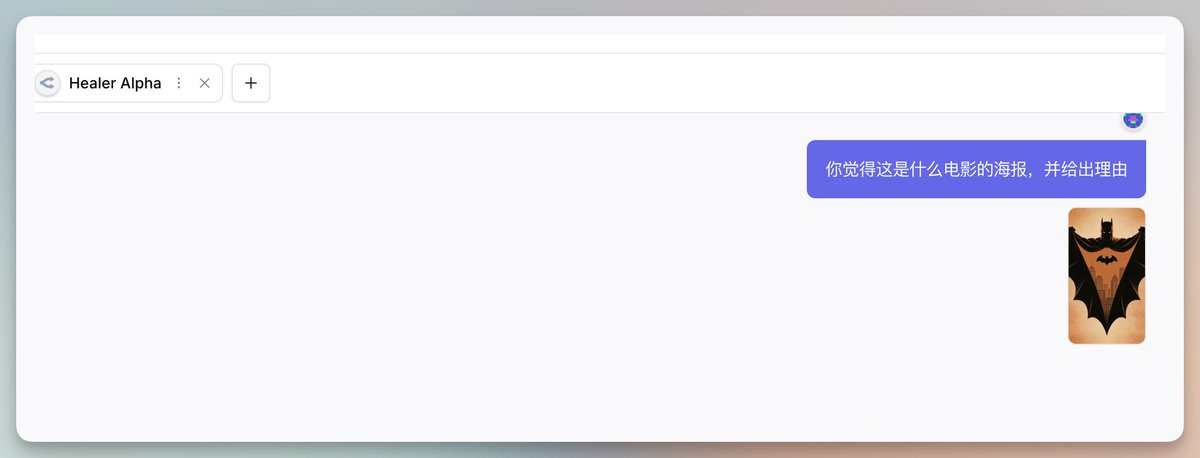
Two stealth models named “Healer Alpha” and “Hunter Alpha” have appeared on OpenRouter, speculated to be DeepSeek V4. Hunter Alpha is described as specifically designed for Agents, with 1 trillion parameters and 1M Tokens, focusing on Agent reliability and instruction following accuracy. This suggests that indie developers building Agents can pay attention to such high-precision models to improve the Agent’s ability to execute complex tasks.
AI Agents Stuck in Awkward Loops ⭐ 7.5
The discussion points out that AI Agents may fall into decision loops due to misunderstanding instructions or insufficient internal logic, for example, in the “Shall I implement it? No” interaction, the Agent still tries to execute the task. This reminds indie developers that when designing Agents, they need to handle user intent recognition and internal decision mechanisms more meticulously, avoiding unnecessary execution and improving user experience and resource efficiency.
CodePilot Mobile Controls Desktop AI ⭐ 7.5
A developer proposed the need for a CodePilot mobile app to remotely control AI programming assistants like Code Pilot, Claude Code, and Codex on multiple desktop devices from a phone. For indie developers, this offers the possibility of managing and deploying AI assistants even when away, and while functionality is limited, it can achieve practical features like switching models, working directories, and remotely viewing progress, enhancing the flexibility of programming work.
Geometric Regularities of AI Model Word Vectors ⭐ 7
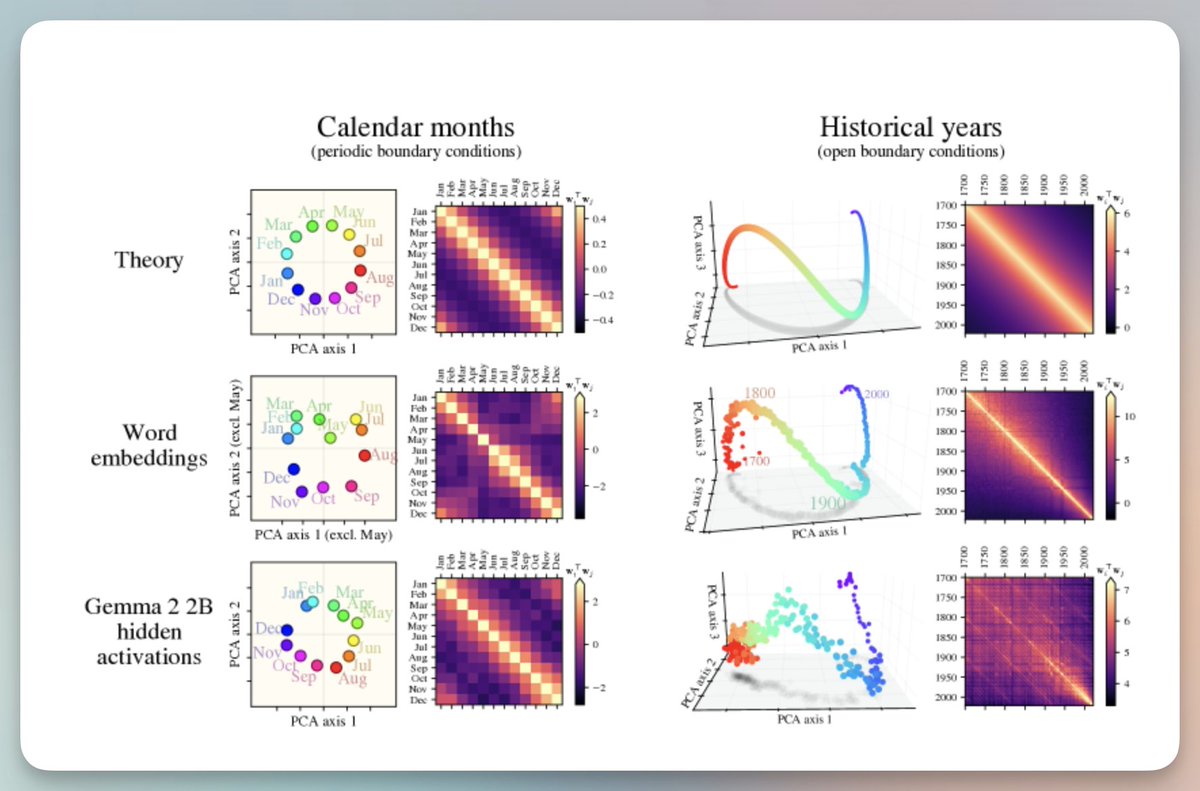
Research found that large model word vectors exhibit regular patterns in 2D space, such as months arranged in circles, historical years forming wavy lines, and city latitudes/longitudes being linearly decodable. This is because when co-occurrence statistics have translational symmetry, word embeddings automatically learn Fourier representations. For indie developers, this reveals the deep mechanisms of AI model internal representations, potentially inspiring new data encoding and model design methods for more efficient processing of time-series and geospatial data.
LLMs and Brain Function Increasingly Similar ⭐ 6
Research indicates that large language models (LLMs) and human brain functions are becoming increasingly similar in certain revealed aspects. This inspires indie developers to draw inspiration from neuroscience to design more efficient and biologically plausible AI model architectures and learning algorithms, thereby promoting the development of AI technology.
LLMs Performance Not Significantly Improved? ⭐ 6
The article discusses the view that LLMs’ performance on the SWE-bench benchmark has not significantly improved. Indie developers, when evaluating and selecting models, should focus on performance metrics in actual application scenarios, rather than blindly pursuing the latest models, and also understand the current limitations of LLMs in code generation and understanding.
AI-Generated Posters Combined with Search Improve Quality ⭐ 6.5
One-sentence AI-generated posters can significantly improve their quality when combined with search functions like C-large’s pipellm. This suggests that indie developers, when using AI for creative design, can produce more accurate and attractive content by combining multimodal input and external information search.

Obsidian Journal Combined with CC Dialogue Music Playback ⭐ 7
The author shared a feature that adds a 30-day playlist to Obsidian journals, automatically reading notes through CC dialogue, playing related music, and providing introductions and popular science. This offers indie developers a creative idea for integrating personal information management and AI interaction, allowing them to explore more automated and personalized features based on note content to enhance user experience.

Indie Dev & SaaS
Indie Developer Job Search Experience Sharing ⭐ 8
An engineer with four years of backend indie development experience shared their journey from indie development to job searching, specifically hoping to find AI-related or creative work. This reflects indie developers’ re-evaluation of skills and direction in a changing market, and their exploration of combining their strengths with the AI field, providing a reference for other indie developers considering career transitions.

Entrepreneur Interview: Beware of Funding Delusion ⭐ 9
Entrepreneur Tang Xinger’s podcast shares that funding can lead to “delusion,” causing over-expansion, while the key to success lies in focusing on cash flow, small and beautiful projects, and user willingness to pay, rather than blindly pursuing grand goals. This provides valuable entrepreneurial advice for indie developers, emphasizing the importance of staying clear-headed, starting small, and verifying if users are willing to pay for the product.
“Product Thinker”: The Underrated Scarce Talent ⭐ 8
The article points out that the most underrated hire currently is a “product thinker,” not a traditional product manager. This is a rare talent with intuitive understanding of products, the ability to envision the future, and both technical and cultural sensitivity. For indie developers, this emphasizes the importance of product judgment, user narrative, and the cross-integration of technology and culture, abilities that are increasingly valuable in AI-era product development.

Reduce Ineffective I/O, Protect Context Window ⭐ 6.5
Indie developers should “reduce ineffective I/O, and protect their context window.” This brief advice highlights the importance of optimizing resource usage in AI application development. For LLMs, the Context Window is a valuable and limited resource; effective management of input and output can improve efficiency, reduce costs, and optimize Agent performance.
AI Popularization and Human Complexity ⭐ 6
The view suggests that AI will simplify a few things but create many complex ones, believing that the most fundamental human nature is “entropy reduction, complexity.” This prompts indie developers to consider how to deal with the new complexities that arise as AI simplifies tasks, and to discover new product opportunities within them, rather than being misled by the simplifying effects of AI.
Russian Platforms Support AI Product Subscriptions ⭐ 6
News indicates that some Russian platforms have started supporting AI product subscriptions. This provides new market information for indie developers, showing that the business model for AI products is gradually maturing and diversifying globally. Indie developers can pay attention to these emerging markets to find new monetization opportunities.
Open Source Projects
DuckDB Processing Big Data on MacBook ⭐ 6
The article explores the possibility of using DuckDB for big data processing on the cheapest MacBook, and community discussions also confirm the powerful performance of M-series chips in AI Agent orchestration and big data processing. This is a positive signal for indie developers, meaning that efficient AI development and data analysis work can be done without expensive hardware, lowering the technical barrier.
Git Checkout, Reset and Restore ⭐ 6
The article thoroughly explains the differences and uses of checkout, reset, and restore commands in Git. For indie developers, understanding these Git commands enables more efficient code version management, especially when frequently switching branches or undoing changes. Mastering the specific functions and effects of each command is crucial.
Industry Trends
AI Facial Recognition Misidentification Leads to Innocent Imprisonment ⭐ 7
An incident where AI facial recognition technology led to the wrongful imprisonment of an innocent woman for several months was exposed, sparking community discussion. This highlights the importance of accuracy and ethical issues in the practical application of AI technology, especially in legal and public safety fields. It reminds indie developers to be cautious when using AI and to consider the importance of human review and verification to avoid similar tragedies.
US Military Suspects Anthropic Supply Chain Risk ⭐ 7.5
The article explores various theories about why the US Department of Defense listed Anthropic as a “supply chain risk,” including concerns about AI “soul,” constitutional issues, and hallucinations. This reflects the strategic importance and potential risks of large AI models in national security, and indie developers should pay attention to compliance, transparency, and potential ethical and security challenges in AI technology applications.

YouTube Ad Revenue Surpasses Traditional Media ⭐ 6
Data shows that YouTube’s ad revenue is projected to exceed the combined total of four traditional media companies—Disney, NBCUniversal, Paramount, and Warner Bros.—in 2025. This demonstrates the immense potential of digital platforms for content monetization. For indie developers, it means that video content creation and platform ecosystems remain areas worth deeply exploring.
Social Media Hot Topics
OAuth Outage Disrupts AI Research ⭐ 7
Andrej Karpathy stated that an OAuth service outage brought his “automated research lab” to a halt, highlighting the high dependency of AI systems on third-party services. This reminds indie developers, when building AI applications, to pay attention to service stability and consider fault tolerance mechanisms and backup plans to cope with potential “smart blackouts.”