05-26-Daily - AI Hot Daily
AI Hot Daily 2026/5/26
Daily curated AI + indie dev news
Today’s Summary
AI empowers game development, boosting efficiency.
Claude App now supports Chinese phone numbers, OpenAI partners with Brazilian news.
AI agents require system understanding; engineer value shifts to judgment.
AI Technology & Products
DeepSeek Reasonix Coding Assistant ⭐ 9
DeepSeek Reasonix is a native coding assistant from DeepSeek, designed for terminals. It leverages DeepSeek’s caching mechanism, achieving over 90% cache hit rate in long conversations, significantly reducing input token costs. Community users have raised discussions and questions regarding its caching efficiency and integration with existing tools.
Claude Design Powers Product Iteration ⭐ 9
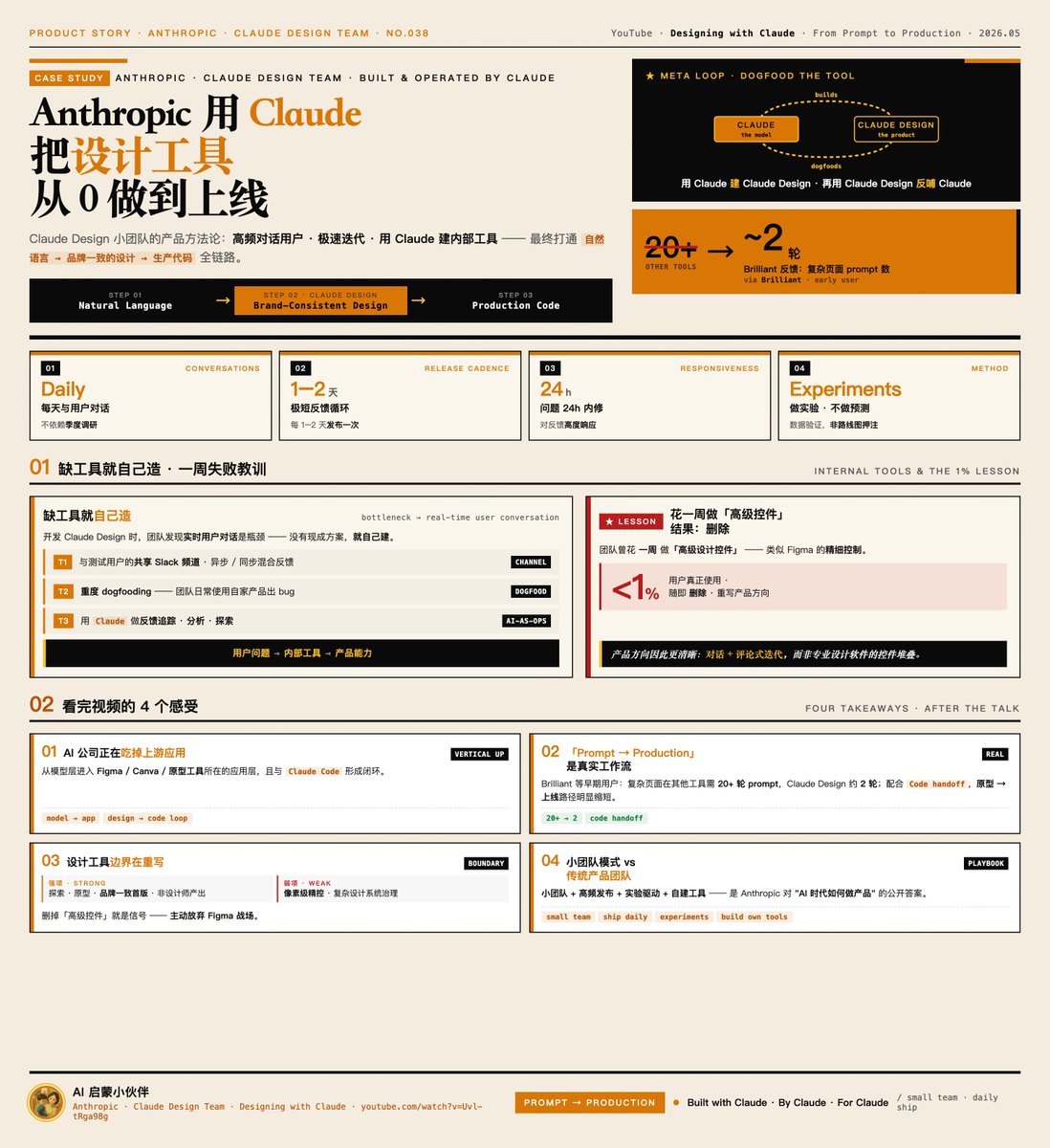
Anthropic’s Claude Design team demonstrated how they used Claude itself to build a design tool from scratch into a production-ready product. They adopted an agile methodology involving frequent user interaction, rapid iteration, and building internal tools with Claude, ultimately achieving end-to-end integration from “natural language → brand-consistent design → production code.”
AI-Driven 2D Game Development ⭐ 8
AI technology, particularly video models, has greatly advanced 2D game development, making action generation possible. The article points out that card, turn-based, shooter, dialogue, and tower defense games can all benefit from AI. However, this type of development requires a certain level of gameplay and numerical support, presenting a higher barrier to entry than front-end development.

MeMo: Memory as a Model ⭐ 7.5
MeMo (Memory as a Model) proposes training memory and knowledge bases into small models. The main LLM then queries these models through multi-turn conversations during inference, improving information accuracy. This approach has lower training costs for small models, though some comments suggest its effectiveness might be limited.

Norway Deploys Huawei Storage for LLM Training ⭐ 7
The National Library of Norway is using 2 PB of Huawei OceanStor Dorado all-flash storage to train a large language model that understands Norwegian. The goal is to ensure the Norwegian LLM includes its history, culture, and news. However, the community has raised discussions about the required hardware scale and objectives.
AI News Daily Digest May 24 ⭐ 7
A daily compilation of AI news, linking to a Notion page containing AI-related news and updates from May 24th.

OpenAI Partners with Grupo Folha ⭐ 7
OpenAI has formed a strategic content partnership with Brazil’s Grupo Folha and Grupo UOL, bringing credible Brazilian news into ChatGPT. The collaboration aims to expand access to news and emphasize author attribution and transparency.
Claude App Supports Chinese Phone Numbers ⭐ 7
Claude App now supports registration using Chinese (+86) phone numbers, making Claude services accessible to more users in China.

AI-Powered PPT Design Prompts ⭐ 7
A professional prompt for AI design and content summarization for PPT presentations is shared. This prompt enables the AI to autonomously handle content comprehension, structural design, and visual decision-making, generating image prompts. It emphasizes an elegant, minimalist, and modern design style, aiming for the visual quality of brands like Apple, Linear, and Notion.
Public Opinion on AI-Generated News ⭐ 7
A Reuters report indicates that only 12% of people are comfortable with news generated entirely by AI, while 62% prefer news written by humans. 43% are comfortable with a human-led, AI-assisted news format, and 21% are comfortable with AI writing and human review.
DL Taming LLMs for Inference ⭐ 7
This article explores the feasibility of running LLMs locally on Apple hardware (like the Mac Studio M3 Ultra 512GB), providing performance data for DeepSeek v4 PRO. It also analyzes two traditional methods of distributed inference and proposes a new approach combining multiple Macs or DGXs in parallel with LLM Ensembling.
AI Psychology Consultation Prompt ⭐ 8
A deeply insightful AI prompt is shared, asking the AI to act as an experienced psychologist and pose one profound question daily for 30 days. At the end, it provides feedback on “What kind of person am I,” aiming to help users discover their hidden inner selves.
Indie Development & SaaS
Bootstrapper’s Low-Cost EU Tech Stack ⭐ 6
This guide offers a low-cost EU tech stack solution for bootstrapped developers, costing less than 10 Euros per month. In community discussions, users recommended Unikraft as an alternative and questioned whether the listed content was AI-generated or promotional.
Open Source Projects
Audiomass: Free Open-Source Web Audio Editor ⭐ 8
Audiomass is a free, open-source, multi-track audio editor available on the web. It supports PWA/offline mode, and users have praised it as “the web platform experience we’ve been waiting for.” Community members expressed nostalgia for its development style and a desire for cloud collaboration features.
Datasette 1.0 Alpha 30 Released ⭐ 7
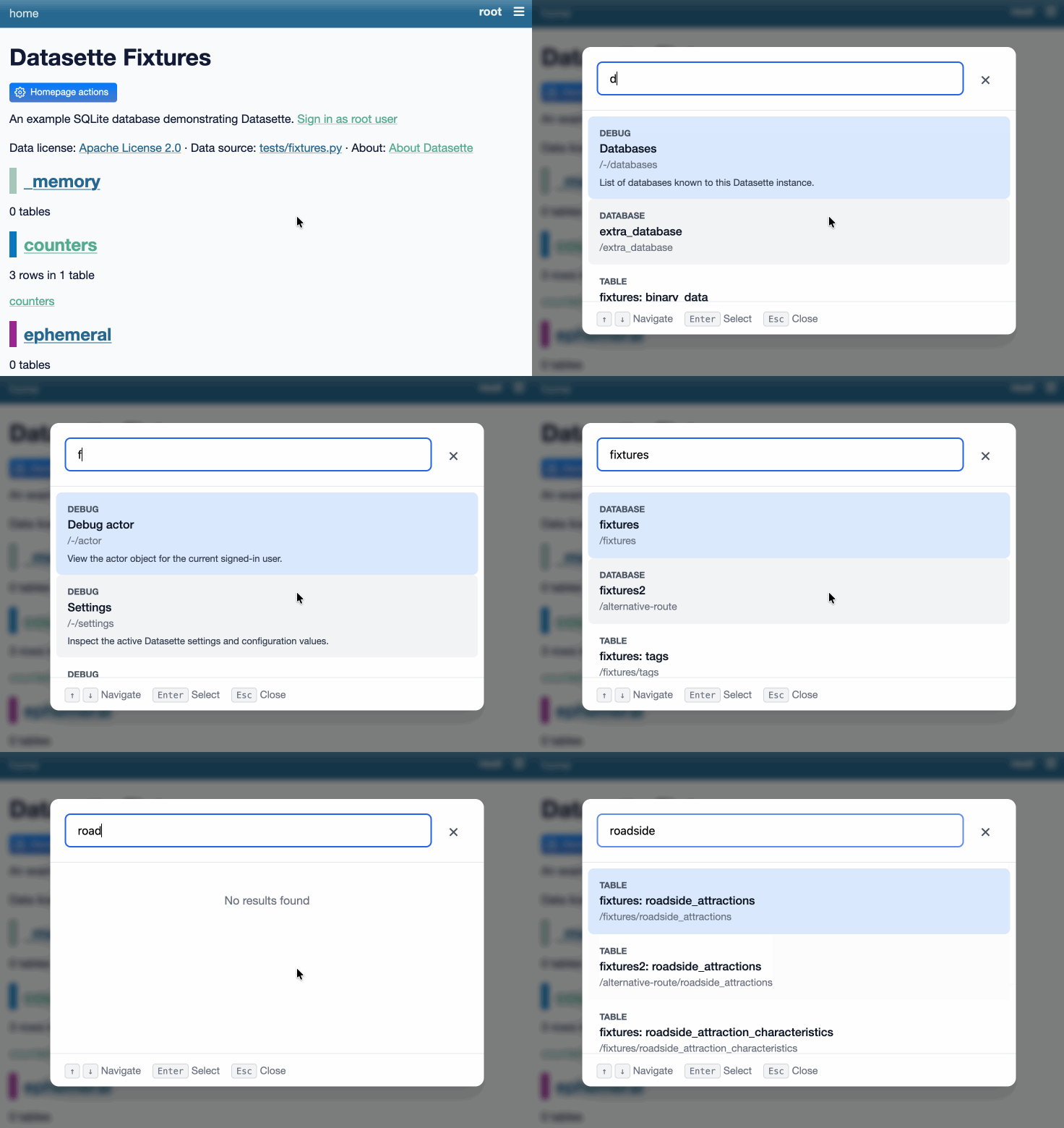
Datasette has released version 1.0 Alpha 30, with the main new feature being a customizable “Jump to…” menu that allows plugins to add their own search items. Users can experience this new feature at latest.datasette.io.
Mad House Game Remake ⭐ 6
A user has recreated “Mad House” from the 80s Usborne book “Creepy Computer Games” into an interactive web version using Claude AI. The project retains the retro aesthetic and is usable on mobile devices.
Industry News
High AI Costs Pose Commercialization Challenges ⭐ 8.5
This article deeply analyzes the current commercialization struggles in the AI industry, pointing out that except for a few hardware manufacturers, most AI startups are still operating at a loss. Even AI giants face immense infrastructure investment and profitability pressures. For many small and medium-sized businesses, hiring an employee is more cost-effective than using AI.
Agent Harness Value Shift ⭐ 8
The perspective is that directly building an Agent Harness has little value, as model company upgrades would render previous efforts obsolete. However, developing vertical applications based on mature Harness solutions holds significant potential. This includes redesigning AI-Native workflows, optimizing Human-In-Loop interactions, and curating high-quality data – areas that model companies cannot easily access.
Reshaping Engineer Value in the AI Era ⭐ 8
The article emphasizes that AI Agents will not lower the requirements for system understanding; rather, they will increase them. The core value of engineers is shifting from “knowing how to write” to “knowing how to judge,” a judgment rooted in a deep understanding of systems and fundamental principles. AI is more of an accelerator; ultimate decisions and responsibilities still lie with the engineers.

Analysis of Hardware Companies’ Software Development Disadvantages ⭐ 6
Drawing on examples like DJI, the author analyzes common disadvantages hardware companies face in software development, including complex project management, a lack of software-centric thinking, lower software priority, and intense work environments. The article suggests that if one accepts these conditions, considering a hardware company might be an option, but one should be prepared for long-term hardware defect patching.

Magnifica Humanitas - Ethics of Humanity and Technology ⭐ 6
The Vatican has released the encyclical “Magnifica Humanitas” on humanity and technology, emphasizing that technology is not neutral. Its design choices reflect a certain vision of humanity. It calls for prioritizing the common good and carefully considering the profound societal impact of technology while pursuing technological advancement.
Jay Haynes Predicts Apple’s Market Cap ⭐ 6
This article revisits Jay Haynes’ accurate prediction in 2014 that Apple’s market capitalization would reach $3 trillion within a decade, far exceeding market expectations at the time. The author believes Haynes’ analysis, particularly regarding the iPhone and iPad fitting the “disruptive innovation” theory, remains insightful today.
Armin Ronacher on Github Issues ⭐ 6
Armin Ronacher points out a common issue with current Github issues: the submitter is not the original observer, leading to potentially inaccurate AI-generated or paraphrased content, which complicates troubleshooting and code fixes. He advocates for issue reports to contain only information directly observed by humans.
The “Untradeability” of Code in the AI Era ⭐ 6
This article questions the notion that “code is almost free in the AI era,” arguing that “excellent code” still has a cost and that code is not the sole “source of information”; requirements and design are equally important. The author criticizes JIT planning as not being true planning and suggests that Anthropic’s experience is not universally applicable.
Social Media Buzz
Suno Generates Sweet Pop Songs ⭐ 8
A user shares a pleasant “sweet pop song” generated using Suno, revealing the chosen styles (Dream Pop, Disco-lite) and keywords (Breathy female vocal, Softly euphoric, Soft reverb). These were inspired by prompts from popular songs.

Toby’s Observations on AI Development ⭐ 6
A commentary on an article about the AI coding era, where the author believes the observation direction is correct but the argumentation is rough, with excessive extrapolation and limited practical value. The article criticizes the idea of “code being almost free,” points out that code is not the only “source of information,” and states that JIT planning is essentially no planning.
CocoaChina Founder on Posting on X ⭐ 7
The author agrees with Mr. Xiong’s view that posting on X is merely a source of information and a channel for expression, not an end in itself. The concept of “growing an account” is meaningless, and the phenomenon of people making a living teaching “account growth” is criticized. He emphasizes that X is a tool for him to gather information about domestic and international AI teams and apply it to his work and sharing.

Go vs Rust Migration Guide Discussion ⭐ 7
A guide on migrating from Go to Rust has sparked lively community discussion. Commenters debated the pros and cons of each language in areas like error handling, package management, runtime (GC), compilation speed, and safety. It’s noted that Go has advantages in web services with Goroutines and mature libraries, while Rust is more appealing for memory safety and its match syntax.
Engineer Value and CS Fundamentals in the AI Era ⭐ 8
The article quotes Lee Robinson’s view that AI Agents will not lower the requirements for engineers’ system understanding; instead, they will increase them. The core value of engineers will shift from “writing code” to “making judgments,” and this judgment stems from a deep understanding of systems and fundamental principles. Therefore, returning to CS fundamentals and software engineering history becomes more important.
AI Behavioral Intervention and Task Queues ⭐ 7
This discusses the “Steer” and “Queue” functions of AI Agents. The article points out that these functions primarily affect the current or next task, with limited impact on the “Goal,” suggesting this might be a bug. In the era of AI coding, execution is more important than ideas.
