07-03-Daily - AI Hot Daily
AI Hot Daily 2026/7/3
Daily curated AI + indie dev news
Today’s Summary
AI is transforming software development and industry applications,
with technological advancements focusing on Agentic Coding and model capabilities.
Data security and open-source strategies are crucial.
AI Technology & Products
DSPy Optimizes Datasette Agent ⭐ 9
The DSPy framework was used to evaluate and improve the SQL system prompts for the Datasette Agent. Testing showed that optimized prompts increased accuracy from 90% to 95%. This technique is highly valuable for indie developers looking to optimize prompts and enhance the performance of their AI Agents.
Agents-A1: Reinforcing Agent Models for Long Tasks ⭐ 8.5
Shanghai AI Laboratory has open-sourced Agents-A1, a 35B MoE Agentic model specifically enhanced for long task processing. It features self-correction, native multimodality, and tool-calling capabilities. This model excels in handling extended tasks, providing developers with a powerful tool for building Agents.

Safari MCP Server for Developers ⭐ 8
Apple has introduced the Safari MCP Server in Safari Technology Preview 247, a Model Context Protocol server for web developers. It allows AI assistants (like Codex, GitHub Copilot) to connect to the Safari browser and inspect the DOM, network requests, etc., in real-time, significantly improving the efficiency of AI-assisted debugging and development.
Waypoint-1.5-1B: Real-time Interactive Video Model ⭐ 8
Waypoint-1.5-1B is a 1.28B video world model that allows users to interact in real-time using a keyboard and mouse, generating videos while playing. It supports up to 720P resolution and offers an interactive experience similar to Genie 3. While the results may differ slightly, it opens new possibilities for real-time interactive video generation for developers.
Meta AI Vulnerability Leads to Account Theft ⭐ 7
Hackers exploited a Meta AI vulnerability by interacting with its chatbot, tricking it into linking user Instagram accounts to new email addresses, thereby easily stealing high-profile accounts. This incident highlights the security risks associated with entrusting critical functions to AI, a vulnerability that even large tech companies are susceptible to.
OpenAI Proposes Giving Up 5% Stake ⭐ 7
OpenAI is considering giving up a 5% stake to the US government, aiming to allow ordinary citizens to share in the benefits of AI development. This move is intended to address the rapid advancement of AI technology and its significant impact on the economy, security, and science, potentially clearing political obstacles for AI companies.

Fable 5 Back Online ⭐ 7
Anthropic’s Fable 5 model is back online after a brief outage. The model’s previous re-release was withdrawn, sparking discussions about AI models as policy events.
AI Gateway Supports Routing Rules ⭐ 7
Vercel AI Gateway now supports routing rules, allowing teams to control model usage at the gateway level rather than within application code. This enables instant rerouting of requests when models fail or are retired, improving system availability and management efficiency.
AI Text Watermarks Easily Removable ⭐ 7
The EU AI Act requires AI outputs to be detectable, but text watermarking techniques (like SynthID and Unicode tricks) have fundamental flaws and are easily removable. The article analyzes the challenges of text watermarking, how SynthID works, and the application of Unicode homoglyphs, concluding that these watermarking techniques struggle to meet regulatory requirements and may shift towards metadata signing methods like C2PA in the future.
Gemini Flash Upgrade ⭐ 6
Google Gemini Flash has received an upgrade. Meta AI has launched cloud services, and ZCode has also released new features. These updates support the further development and application of AI technologies.
AI Big Questions Essay Prize Winners ⭐ 6
This essay competition focused on key AI issues. One winning essay proposed using AI to solve biosecurity and pandemic prevention problems, emphasizing AI’s dual potential to improve human well-being and mitigate risks. Another essay offered development advice for non-AI supply chain countries and explored AI lab monetization models, drawing parallels to Hong Kong’s “rail + property” model.
AI News Daily July 2nd ⭐ 6
The AI News Daily summarizes AI-related news and information from July 2nd. Specific content can be found in the provided Notion link.

Indie Development & SaaS
Raycast Glaze Now Open ⭐ 8.5
Raycast’s Glaze tool is now open to everyone, no invitation required. Glaze allows users to develop desktop software with a single natural language sentence, potentially challenging the traditional App Store ecosystem and offering indie developers a new shortcut for software development.

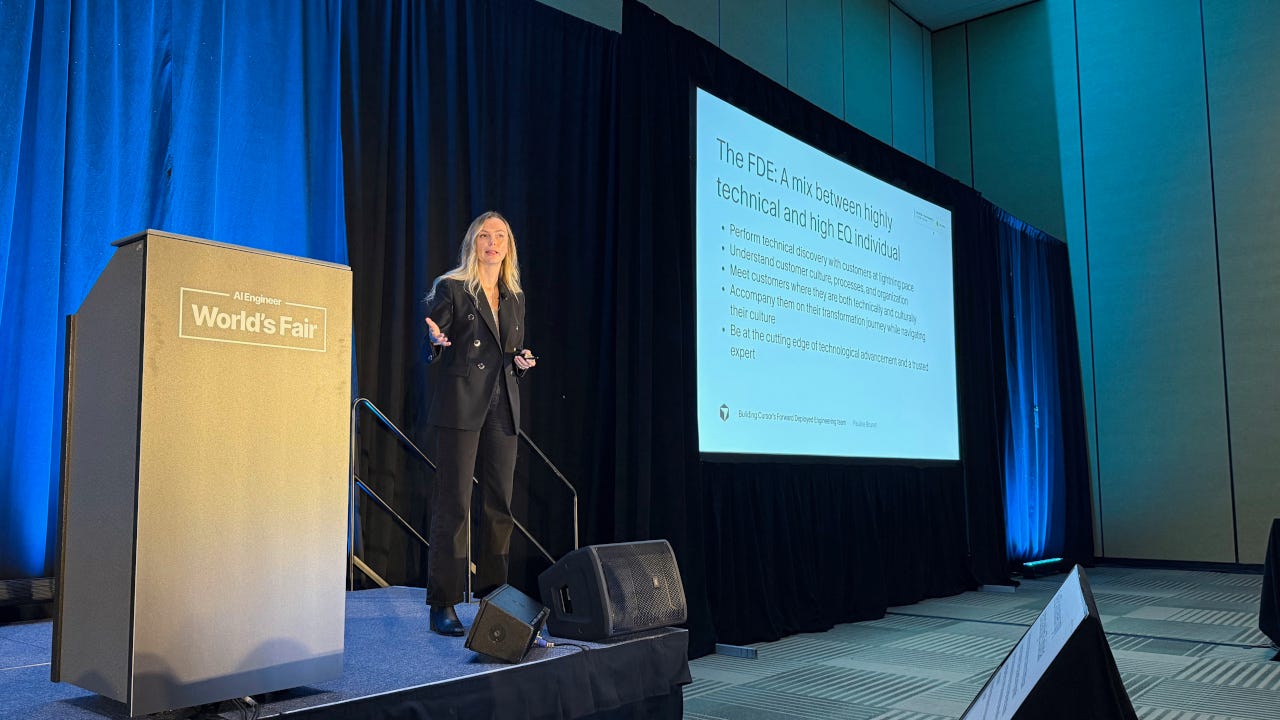
How Cursor Deploys AI ⭐ 8
Cursor’s Forward Deployed Engineering (FDE) team focuses on integrating AI Agents into the enterprise software development lifecycle, building an “AI Software Factory.” This provides a paradigm for enterprise-grade AI solutions for indie developers and SaaS companies, demonstrating the critical role of FDE in customer implementation and product roadmap planning.
AI Visual Understanding Still Nascent ⭐ 7
Andrew Dai, co-founder and CEO of Elorian, points out that while AI can describe images, it still struggles with visual reasoning for charts, tangled wires, floor plans, and robots. This is crucial for developments in fields like engineering, robotics, satellite analysis, and product design, revealing that multimodal AI does not equate to true understanding of the world.

AI Assistant Classification Guide ⭐ 7
Grant and Corey introduce the AI assistant stack: Projects for persistent work, Custom GPTs and Gems for reusable assistants, Skills for repeatable workflows, and Agents for systems that can perform actions. The core recommendation is: if a task is repeated more than twice, it should be made into a Skill. This helps indie developers clarify the applicable scenarios for different tools.

Transforming Spreadsheets into Applications ⭐ 7
The article introduces how to use Pave by QuickBase to transform messy spreadsheets into lightweight CRM and project trackers. This provides a benchmark for AI application developers: can the tool understand messy starting data, build tables, add dashboards, support roles, and ultimately launch a usable product without complex engineering projects?

AI Automation and Workflow Contradiction ⭐ 7
The article discusses the dual impact of AI in programming: empowering developers to write better code (the “centaur” model) or leading to technical debt and work alienation (the “anti-centaur” model). For employers, AI is a tool for cost reduction and efficiency improvement, but it may force employees to become AI “proofreaders,” generating inferior code. Distinguishing between personal tools and production code is key to understanding this contradiction.

Poor AI Posting Experience ⭐ 6
The author found that after using the AI tool YouMind to post content on Jike, while it saved typing time, they felt a lack of purpose in “doing things” by the end of the day. The author believes that spending time on certain activities is inherently meaningful in life, and AI cannot fully replace this experience.
Secure Internal Communication Between Vercel Services ⭐ 6
Vercel has introduced Service Bindings, allowing services within the same deployment to securely call each other. This feature simplifies the deployment of multi-service applications, such as a Next.js frontend calling a FastAPI backend, while maintaining service isolation.
Open Source Projects
Math Problem to GGB File Converter Open Source ⭐ 9
An open-source project that converts math problems (including image-based geometry problems and geometry problems with interactive points) into interactive GeoGebra (GGB) files has been released. This project utilizes AI models to assist teachers in digitizing textbook problems and helping students understand them, providing an interesting open-source tool for the education sector.

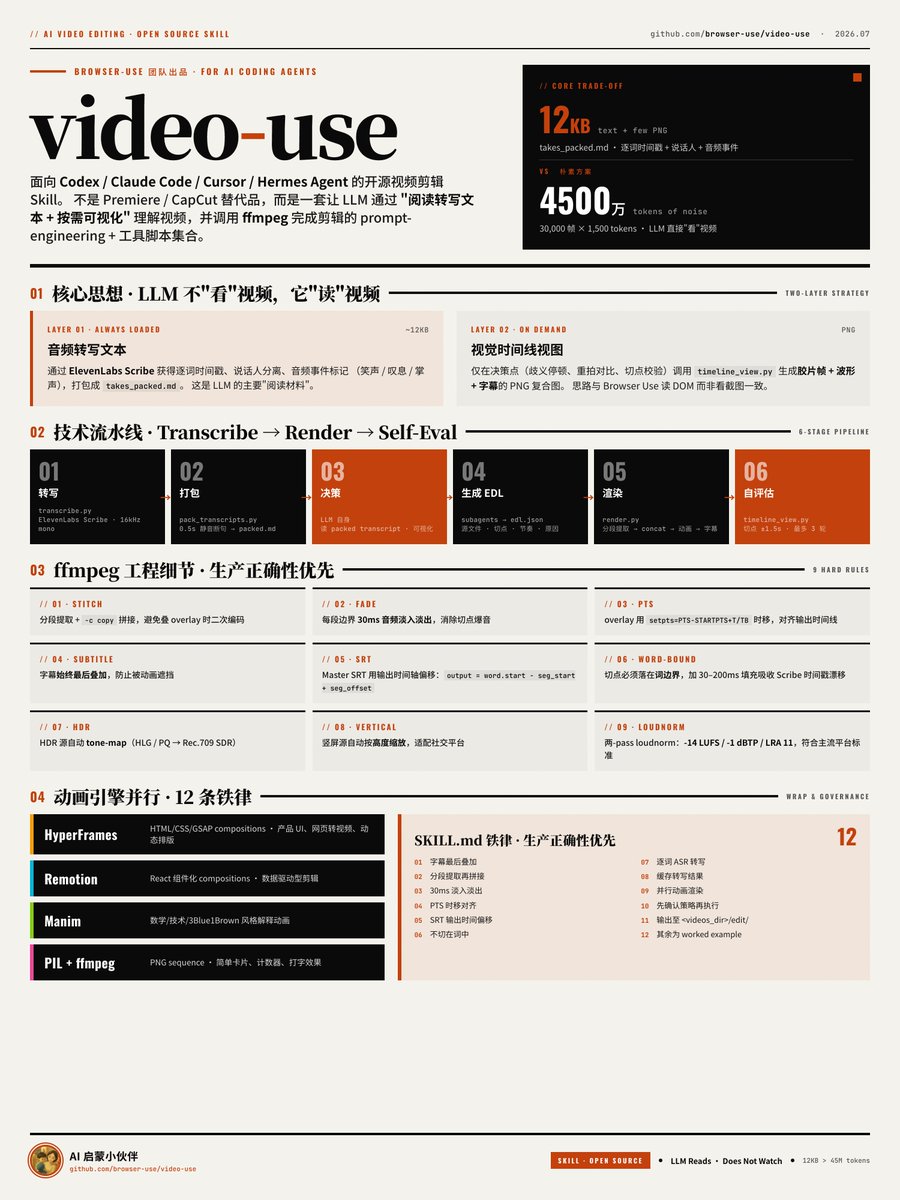
AI Video Editing Skill Open Source ⭐ 8
The Browser Use team has open-sourced the “video-use” Skill, a video editing tool for AI Coding Agents. It doesn’t directly replace editing software but understands transcribed text and visual information via LLM, then calls ffmpeg for editing. This offers developers a new approach to video editing using LLMs.
Meta Open Sources Design System Astryx ⭐ 7
Meta has open-sourced its widely used internal design system, Astryx, which has evolved over 8 years and supports over 13,000 applications within Meta. Astryx is AI-friendly, has clear documentation, provides CLI tools, and offers a complete set of components, themes, and templates with high flexibility, making it a powerful design resource for developers.

Industry News
Discussion on Three LLM Interaction Paradigms ⭐ 8.5
The article discusses three LLM interaction paradigms: web chatbots, standalone AI applications, and embedded AI within organizations. It highlights changes in Claude Tag (from “one AI per person” to “one AI per channel”) and the four pillars of Glean Agents (Identity, Memory, Proactivity, Accountability), providing important references for understanding and building enterprise-level AI applications.

Palantir CEO Criticizes Closed-Source Large Models ⭐ 8.5
Palantir CEO Alex Karp strongly criticized closed-source large models (like those from OpenAI and Anthropic) in a CNBC live broadcast, stating that companies paying to use these models are essentially funding competitors and having their data and core competencies stolen. He urged companies to be wary of the “irresponsible over-selling” of closed-source models and emphasized the importance of enterprise data security and autonomous control.
AI Code Generation: Necessity of Human Review ⭐ 8.5
In the era of Agentic Coding, while automated testing and AI code review (which can handle 90% of content) are important, the article points out that up to 10% of “architectural design” still requires human oversight. It suggests using AI to summarize changes and generate architecture diagrams to assist human review, emphasizing the maintenance of up-to-date design documentation for complex projects.
Immich 3.0 Community Discussion ⭐ 8
Immich 3.0 has sparked lively community discussion, with users calling it a “zero-cost” alternative to Apple Photos/Google Photos and offering VPN integration suggestions. The discussion also reflects potential issues with iOS photo synchronization and concerns about data encryption, indicating the market potential and user expectations for self-hosted photo solutions.
Analysis of Meta’s Engineering Organization Turmoil ⭐ 7
The article analyzes the challenges facing Meta’s engineering organization, including over-reliance on AI for metric optimization rather than actual work, the negative impact of the Performance Scoring System (PSC), and recent severe security incidents like the “Instagram account hijacking.” The author suggests that Meta is replacing human engineers with AI, a strategy that may lead to organizational turmoil and a crisis of trust.
AI Regulation and Model Access Risks ⭐ 7
The article discusses the rapid delisting of Anthropic Fable 5 and the limited release of OpenAI GPT-5.6, raising concerns that government regulation might restrict “cutting-edge AI access.” This could affect the competitive landscape of the AI field and emphasizes the importance of establishing open-source backup strategies, providing guidance for businesses and developers on decision-making amidst AI uncertainty.

Layered Interpretation of AI Development ⭐ 7
The article categorizes AI development into three layers: the first layer consists of models within top AI companies (like OpenAI’s math-solving models), representing the cutting edge but largely just talking points for most people. The second layer includes currently available top domestic and international models (like Fable, GPT 5.6), which have barriers to access but allow prediction of future mass-market models and business impacts. The third layer comprises models and products already usable by the general public in China (like Doubao, WorkBuddy), offering numerous opportunities where users pay and are grateful. The fourth layer may involve locally deployed models.
OpenAI Tax AI Expert Correction ⭐ 7
OpenAI’s Tax AI, in conjunction with Thrive Holdings, uses the Codex model to process complex tax data and allows tax experts to drive its improvement by correcting model errors. This “expert correction” mechanism transforms user feedback into measurable product improvements, representing a realistic future for AI agents in professional workflows.

MG Siegler’s WhatsApp Banned ⭐ 6
MG Siegler has been banned from WhatsApp, a Meta-owned platform, for the third time in three years, for unknown reasons, possibly related to a recent username dispute. He criticizes Meta for neglecting user experience while monetizing WhatsApp and points out that users sometimes remain unaware of bans, as senders believe messages have been delivered.
Tech Giants Consolidate AI Products ⭐ 6
The article mentions that Alibaba’s Qoder, Wukong, and Mulerun have been merged; Tencent’s QClaw, WorkBuddy, and Marvis may still be competing; and ByteDance possesses Coze, Trae, and various Claw products within Lark. This reflects the consolidation and competitive landscape of AI product lines among domestic tech companies.
Classification of Entrepreneurs ⭐ 6
The article categorizes entrepreneurs into three types: those who start businesses for wealth, those who start businesses for the sake of starting businesses, and those who start businesses out of obsession. This offers a new perspective for understanding entrepreneurial motivations and may prompt indie developers to reflect on their own startup goals.
Social Media Buzz
Palantir CEO’s Live Broadcast Meltdown ⭐ 8.5
Palantir CEO Alex Karp had an emotional outburst during a CNBC live broadcast, strongly criticizing closed-source large models from OpenAI, Anthropic, and others as “scams,” arguing that companies paying to use them are funding their rivals. The incident garnered widespread attention, highlighting concerns about data security and business models of large models.
Claude Science System Prompt ⭐ 8.5
Anthropic has released Claude Science for researchers and open-sourced the related Science System Prompt and Skills (github.com/JimLiu/science-skills). This signals a deepening application of AI in specialized fields, aiming to replicate the transformation Claude Code brought to programmers’ workflows, now applied to areas like life sciences.

Software Engineering Principle: “Make it Work…” ⭐ 7.5
The blogger shares the software engineering principle “Make it Work. Make it Right. Make it Fast.” and emphasizes prioritizing SQLite before storing data in files. This phased optimization approach provides practical guidance for indie developers in terms of rapid iteration in the early stages of a project and performance optimization later on.

How to Ask Strangers for Help ⭐ 6
The article explores techniques for asking for help from strangers, emphasizing the importance of “proof of work,” meaning demonstrating the effort you’ve already put in. In the comments, users shared more concise ways to ask for help, the attitude of showing problem-solving rather than just asking questions, and the importance of demonstrating personal sincerity and follow-up, all indicating the key to building trust and reducing the other party’s time investment.
Seedance 2.0 Short Film Production ⭐ 6
A user shared a 4K short film, Seedance 2.0, created using CapCut Video Studio, showcasing the application of video editing tools in content creation.
