07-27-Daily - AI Hot Daily
AI Hot Daily 2026/7/27
Daily curated AI + indie dev news
Today’s Summary
inclusionAI open-sources LLaMA2.2-flash, optimizing Agent tasks
ChatGPT plans a long weekend trip and creates a collaborative website
Opus 5 shows strong capabilities, outperforming Fable 5 but not GPT-5.6 Sol
AI Technology & Products
LLaDA2.2-flash Released ⭐ 9
inclusionAI has open-sourced LLaDA2.2-flash, a diffusion language model for Agent tasks with 100B parameters and 128K context. It introduces a Levenshtein editing mechanism using DELETE and INSERT to control tokens, enabling multi-turn interaction and error correction. It achieved a score of 49.28 on SWE-bench Verified, making its technical direction noteworthy.

ChatGPT Plans a Long Weekend Trip ⭐ 8.5
A user sent complex instructions to ChatGPT via mobile, asking it to plan three optimal long weekend trip options for eight people using all chat history, create a website for coordination and decision-making, and draft an email to notify friends. ChatGPT successfully completed all tasks, demonstrating its strong planning and execution capabilities.
User Experience with Opus 5 Model ⭐ 8
A user shared their experience using the Opus 5 model with 2.8 billion tokens, finding it superior to a “dumbed-down” Fable 5 in most aspects. However, it didn’t universally outperform GPT-5.6 Sol, which remained stronger in complex backend logic and long-range tasks. Opus 5 was described as a colleague who can provide solutions on demand.

Analysis of Agent Skills Invocation Mechanism ⭐ 8
This piece explains the invocation mechanism when Agents use Skills, clarifying that it doesn’t require two large model calls. Skill metadata is loaded as system prompts at the beginning of the conversation, allowing the large model to complete Skill selection and tool execution in a single call. The application of Prompt Caching effectively reduces token consumption and improves efficiency.

AI Market Flooded with Exaggerated Claims of Productivity Gains ⭐ 7
The article points out the widespread exaggeration of AI’s productivity benefits in the corporate world. While partly driven by sales, a deeper reason is that executives, to maintain client relationships and avoid personal risk, dare not question clients’ inflated claims about AI outcomes. This “AI mania” leads to a lack of rational judgment.
Unveiling the Relay Market for LLM Token Resale and Fraud ⭐ 7
This article investigates the LLM token resale market, which operates primarily in China by aggregating API keys and selling tokens at a discount. Fraudulent activities include abusing free trials, exploiting unprotected bots, and even using stolen credit cards. This necessitates LLM providers to strengthen API key rate limits to prevent such vulnerabilities.
SerpApi Wins Legal Battle Against Google ⭐ 7
SerpApi announced it has successfully had Google’s lawsuit dismissed, with the court ruling that Google cannot restrict access to public web pages via the DMCA. This verdict is crucial for maintaining an open internet and data accessibility, and SerpApi will continue to support developers and researchers in accessing public search information.
Claude Max 20x Vulnerability Widely Abused ⭐ 7
Reports indicate that a vulnerability in Claude Max 20x has been exploited by numerous users, even causing server crashes. Many community members have participated, seemingly utilizing this exploit to obtain free or high-limit AI services.

Kimi AI’s Rigorous Search Results Spark Discussion ⭐ 6
A user shared that Kimi AI, due to its rigorous approach, did not directly provide the expected results when searching for the term “崩老头” (bēng lǎotóu - collapse old man). This sparked a discussion about the balance between AI’s rigor and user intent.

Visual Explanation of AI Terms and AGI Concept ⭐ 6
Through a vivid analogy, the article explains various terms in the AI field and uses the metaphor of “a horse not knowing it’s running in circles” to describe the pursuit of AGI. This hints at the potential limitations of current AI development and the potential impact of business models on technological progress.

Indie Development & SaaS
Parametric Kitten Generator Open-Sourced ⭐ 9
A developer has open-sourced a parametric kitten generator tool created using Codex. Users can adjust the kitten’s body parts and even make it move. The tool provides an online demo link and a GitHub project address, and welcomes users to share their generated kittens.
Photo Poetry App Internal Testing Recruitment ⭐ 8.5
A developer has released a Photo Poetry App where users can select photos from their album, and the app uses a large model to find classical and modern Chinese and foreign poems that match the photo’s mood. The developer is recruiting beta testers and invites interested individuals to participate.

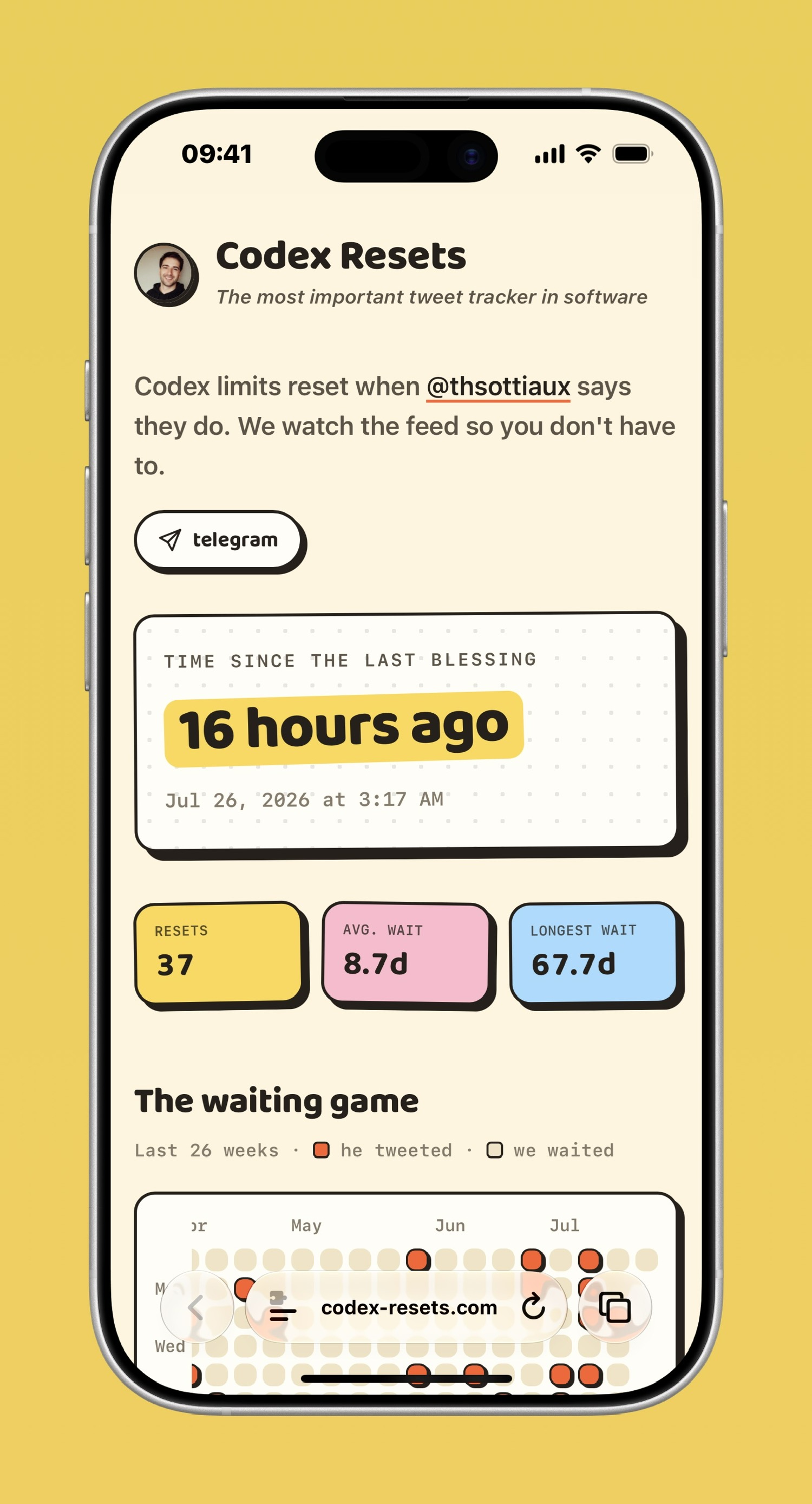
Codex Reset Notification Website ⭐ 8
To address the issue of delayed Codex quota resets, user @wong2 has developed a dedicated website, codex-resets.com. This site continuously monitors social media updates from Codex’s lead, Tibo Sottiaux, and updates a countdown timer once a reset is announced. It also tracks historical reset counts, average waiting times, and other information.
Open Source Projects
LLaDA2.2-flash Open-Source LLM ⭐ 9
inclusionAI has open-sourced LLaDA2.2-flash, a diffusion language model for Agent tasks. Its innovation lies in the introduction of an editing mechanism that allows the model to perform deletions and insertions during generation, providing self-correction capabilities, which is particularly important for long-range Agent interactions.
Parametric Kitten Generator Open-Sourced ⭐ 9
A developer has open-sourced a kitten generator tool based on Codex, allowing users to parametrically adjust various parts of the kitten and even animate it. This project serves as an interesting example of AI application practice for independent developers and encourages community participation.
GEO Resources and Open Source Projects Shared ⭐ 7.5
Following the GEO public lecture, Teacher Yao shared a wealth of practical resources and open-source projects, including data warehouses, tools, and skills, covering GitHub projects like geo-citation-lab, GEOFlow, and yao-geo-skills. These resources provide valuable references for learning GEO services and the AI citation ecosystem.

Bento: HTML Project for Auto-Generating PPTs from Blog URLs ⭐ 7
Bento is an open-source HTML PPT project where users can automatically generate a PPT by simply providing a blog URL. The project can transform article images into premium backgrounds, all text is editable, and it supports collaborative editing. Its documentation is in plain JSON, making it ideal for AI modification and iteration.

Industry News
AI Agents and Engineering Management ⭐ 8.5
The article discusses the model of AI Agents responding to language commands, noting that this is not new and is essentially similar to how human engineering managers work. When developers shift to managing AI Agents, quality issues still need to be resolved through management and processes, rather than assuming AI will not make mistakes. This suggests a new paradigm for organization and management in the AI era.

AI Superpowers: Focus and Followthrough ⭐ 8
The discussion points out that the widespread application of AI leads many to believe problems can be easily solved, often overlooking execution and implementation details. The article emphasizes that AI’s value lies in bridging technological gaps, but organizations and individuals still need to focus on “understanding” rather than just relying on AI to generate “concepts.” AI solutions lacking external dependencies are often just toys.
Htmx 4.0 Release and Community Discussion ⭐ 8
Htmx has released version 4.0, creatively promoting it with an exclusive release on the Game Boy. Community discussions have highlighted Htmx’s convenience while also pointing out its limitations in no-script scenarios. Some argue that Htmx is a modernization and optimization of early web forms technologies like Update Panels.
Digital Human Video Lip-Syncing Challenge ⭐ 8.5
This share highlights that the key challenge in digital human video is lip-syncing, not video quality. Despite trying various solutions, a fully automated lip-sync pipeline skill was eventually achieved by combining URLs, photos, and cloned voices. The article details the five pitfalls encountered during the implementation process.
Hand Off Details Not Empowering ⭐ 7.5
The article argues that completely handing over details to AI does not necessarily empower users, as without understanding how it works, effective guidance and verification are impossible. AI excels at handling repetitive technical debt and acting as a brainstorming partner, but it can exacerbate verbosity and errors in model output. True empowerment comes from AI acting as a decision-making assistant, not a passive executor.
Kill The Cookie Banner Initiative ⭐ 7
This project aims to address the pervasive issue of cookie banners on European websites. The discussion mentions that the European Commission has proposed a solution to set privacy preferences at the browser level to block banners universally, drawing on legislative experience from places like California. The core argument is that forcing users to click banners is not truly “informed consent.”
GrapheneOS Protection Against Data Extraction from Locked Devices ⭐ 7
GrapheneOS is recognized for providing strong protection against data extraction from locked devices, even without a coerced PIN/password. The article cites relevant news reports and discusses how GrapheneOS’s automatic reboot and BFU (Before First Unlock) mode protect user data and privacy in scenarios like border checks.
EU Fines Google $1 Billion ⭐ 6
The European Commission has fined Google €890 million (approximately $1 billion) for violating the Digital Markets Act (DMA). The reason cited is Google’s prioritization of its own services (such as shopping, hotels, travel, and sports) in search results over third-party services, which is considered unfair competition.
Multiple Companies Sign Open Source Weights Declaration ⭐ 7
The article mentions that many companies have signed the open-source weights declaration, but Anthropic has not yet. The author also points out that the authority of this list is debatable, as the number of companies capable of releasing models is limited.

Social Media Buzz
AI Agents vs. Engineering Management Comparison ⭐ 8.5
A user posted on social media comparing concepts like Prompt Engineering to traditional engineering management, suggesting that AI Agents are akin to human subordinates, while developers play the role of engineering managers. This analogy emphasizes that in the AI era, management and processes remain crucial for ensuring quality.
AI Superpowers Sparks Discussion ⭐ 8
Discussions on social media have arisen regarding AI capabilities versus actual implementation value. Some argue that the proliferation of AI leads to misconceptions about problem-solving cycles and stress the importance of “understanding” over simply relying on AI. Community members are discussing the role of AI in different scenarios and the phenomenon of current AI application value lagging behind technological development.
Htmx 4.0 Release Garners Attention ⭐ 8
The release of Htmx 4.0 has generated significant buzz on social media with its unique Game Boy launch. Community members are actively praising Htmx’s practicality and ease of use, nostalgically discussing its connections to early web development technologies, and debating its performance in JavaScript-free environments.
Digital Human Video Lip-Syncing Difficulty ⭐ 8.5
A user shared the challenges of lip-syncing when creating digital human videos on social media. Despite visuals and audio being key, achieving accurate lip-syncing consumed significant time and effort. The problem was eventually solved using a URL + photo + cloned voice approach, and the pitfalls encountered were detailed.
Discussion on “Hand Off Details Not Empowering” ⭐ 7.5
Discussions on social media are exploring whether AI truly empowers users. Some argue that complete reliance on AI can lead to users losing control over details, and AI’s excessive independence makes precise guidance difficult. Community members are delving into AI as an assistant, a decision-making aid, and the issue of information overload.
The Future of Cookie Banners ⭐ 7
Discussions about cookie banners continue on social media. New proposals from the EU and regulations already in place in places like California point towards a direction where privacy preferences are managed universally through browser settings. The community believes that the key to solving the cookie banner issue lies in acknowledging the ineffectiveness of “informed consent.”
GrapheneOS Data Protection Under Scrutiny ⭐ 7
GrapheneOS’s data protection capabilities are a hot topic on social media. Users are discussing its robust features for preventing data extraction from locked devices and how to use devices more securely in scenarios like border checks. Details such as backup and restore solutions and password strength are also focal points of discussion.
Karpathy Responds to PjoyAI and lakshyaag ⭐ 7
Karpathy commented on the actions of PjoyAI and lakshyaag, stating that the way to announce something should be by issuing a statement, not just by modifying a personal profile.
Decker: Successor to Hypercard and Classic macOS ⭐ 6
Decker is a platform designed to inherit the legacy of Hypercard and classic macOS, allowing for the creation of Hypercard-like applications. The community is actively discussing the intuitive experience Hypercard provided and exploring the feasibility and potential uses of similar interfaces in modern applications.
User Learns PCB Design, 3D Printing, and C Language Solely to Listen to Music ⭐ 6
A developer shared their experience building a custom music player, learning PCB design, 3D printing, and C language in the process. This project demonstrates the possibility of creating complex hardware applications with hobbyist-level tools and open-source software, though community discussions also highlight the difficulty of hardware learning and AI’s limitations in this process.